Sensory Edge Data Gateway, Ephemeral
A sensor data processing system that destroys raw data within the processing itself. No footage. No recordings. This is not a privacy policy. It is hardware architecture: the data simply does not survive the process.
Cameras, microphones, and environmental sensors capture what happens in the apartment at the highest resolution available. In conventional systems, sensors like these cannot be deployed in residential environments due to privacy constraints. Here, they are the foundation: the raw data does not survive the process.
Signals are held momentarily in capacitors for nanoseconds only. No disk, no persistent memory, no file is created at any stage.
SEDGE is inherently local: analog signals cannot travel over digital network infrastructure without first becoming a digital file, and that is exactly what the architecture prevents. Privacy and locality are the same thing here.
The core of the patent. The signal flows through an analog resistor array (Crossbar Array) that performs a mathematical computation. The computation itself is what destroys the data: the energy dissipates as heat. These are not two separate events; here, processing and erasure happen simultaneously.
The output from the resistor array contains only abstract features: facial expression, body posture, gait pattern, speech tone. These are representations that cannot be reversed back into footage or recordings.
A physical hardware gate verifies that raw data has been erased before the digital side begins processing. Mathematically, there is simply not enough information to reconstruct an image. This is not a computational difficulty. It is a physical impossibility.
This is the AI stage: a neural network processes only the abstract features. Because the network receives clean input without the noise of raw data, it requires less computing power and achieves accuracy equivalent to full processing systems.
The network produces insights at the precision level of full systems: computer vision, audio analysis, facial recognition, emotion assessment, movement pattern analysis. But the raw material does not exist, never existed as a file, and cannot exist. The output: sentences only. 'Gilad fell,' 'walking slower than usual,' 'high distress level.' No images, no recordings, no video.
Gilad lives in an apartment with SEDGE. 2 AM, a workday starting at 6. Gilad gets up, goes to the kitchen, and eats chocolate.
Same camera, same moment, same raw input. The system identifies two things simultaneously:
Gilad is eating chocolate in the middle of the night.
Gilad is awake at an unusual hour before a workday.
Gilad approved sharing information about sleep habits with the organization. He did not approve sharing about nutrition habits.
Same sensor. Same input. Two different insights. Two different consent rules. The system filters at the output level, not the input level. It knows everything, but shares only what Gilad approved.
SEDGE does not film Gilad. It understands him. And shares only what he chose.
SEDGE begins learning. It does not identify anyone by name, only knows someone is present in the space.
Patterns form. The system identifies that 'Resident A sleeps later in the morning' and 'Resident A goes to the kitchen frequently.'
The organization receives a weekly summary: sleep hours decreased by 12%. The team coordinates an intervention plan.
Gilad manages his morning independently. What once required round-the-clock support staff became quiet background assistance.
A central server located in the building's communications room. One central connection for all apartments. Privacy is built into the hardware architecture itself, not dependent on software settings or organizational policy. Each apartment connects to a dedicated processing channel within the server, physically separated at the hardware level (PCB-Level Isolation). Data from one apartment cannot flow to another's channel. Not by configuration, but by physics.
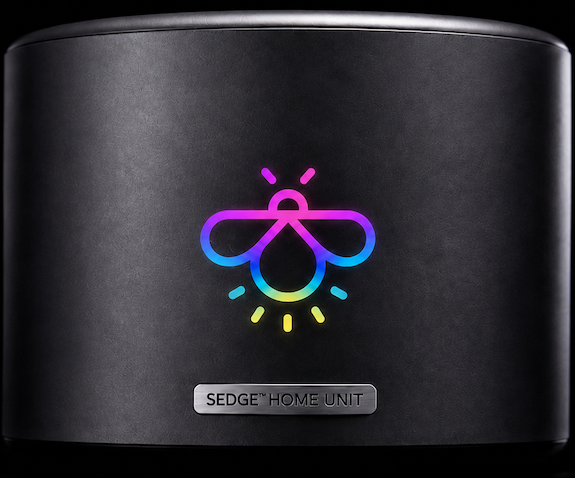
A standalone unit for a single apartment. Suitable for apartments in older buildings, ground-level dwellings, and similar. Same technology, same protection principles, same level of privacy.